The Effect of Static Flexibility Training on Knee Joints Stiffness in Older Adults
DOI:
https://doi.org/10.38040/js.v17i03.1245Abstract
Introduction: Knee joint stiffness is a common musculoskeletal problem among older adults. Age-related physiological changes
lead to a decline in physical function and mobility, resulting in a reduced range of motion in the joints. This study aimed to
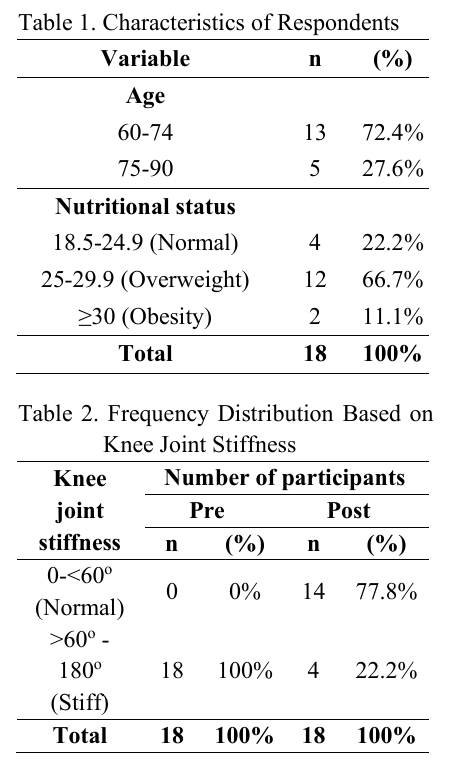
compare knee joint stiffness before and after the implementation of static flexibility training in older adults. Methods: This quantitative experimental study employed a one group pretest–posttest design. A total of 18 older adults experiencing knee joint stiffness at Betheseda Kasih Service Nursing Home were recruited using simple random sampling. Knee joint stiffness was measured using a goniometer and an observation sheet. Data were analyzed using the Wilcoxon signed-rank test. Static flexibility training was conducted six times over a two-week period (three sessions per week), with each session lasting approximately 15 minutes. Each session consisted of five movements performed for 10–20 repetitions. Results: Prior to the intervention, the mean degree of knee
joint stiffness was 75° (classified as stiff). Following the static flexibility training, the mean degree decreased to 48.89°, indicating a return to normal joint mobility. The Wilcoxon test showed a statistically significant effect of static flexibility training on reducing knee joint stiffness (p = .000 < 0.001). Conclusion: Static flexibility training effective for improving joint mobility in older adults as a non-pharmacological approach. It is recommended to compare static and dynamic flexibility training effectiveness reducing knee joint stiffness among older adults in further study.
Downloads
Published
How to Cite
Issue
Section
Citation Check
License
Copyright (c) 2025 Yasinta Lidia Sumarni, Rona Sari Mahaji Putri, Hilda Mazarina Devi

This work is licensed under a Creative Commons Attribution 4.0 International License.
- The journal allows the author to hold the copyright of the article without restrictions.
- The journal allows the author(s) to retain publishing rights without restrictions.
- The legal formal aspect of journal publication accessibility refers to Creative Commons Attribution (CC BY).