The effect of Effleurage Massage and Dysmenorrhea Exercise in Reducing Menstrual Pain in Adolescent Girls
DOI:
https://doi.org/10.38040/js.v17iSp.1392Abstract
Introduction: Dysmenorrhea is a common condition among adolescent girls and often negatively affects academic performance. Many adolescents rely on pharmacological treatment to manage menstrual pain, despite the potential side effects. Interview findings indicate that adolescents have limited knowledge of non-pharmacological pain management methods. Therefore, this study aimed to examine the effects of effleurage massage and dysmenorrhea exercise on reducing menstrual pain in adolescent girls.
Methods: This study employed a quasi-experimental pretest–posttest design with two intervention groups: effleurage massage and dysmenorrhea exercise. The sample consisted of 30 adolescent girls experiencing menstrual pain in Lamongan Regency, selected using purposive sampling and equally divided into two groups (n=15 per group). The independent variables were effleurage massage and dysmenorrhea exercise, while the dependent variable was menstrual pain. Interventions were administered according to standardized operating procedures, and pain intensity was measured using a pain scale observation sheet. The Wilcoxon test was used to assess changes in pain before and after the interventions, while the Mann–Whitney test was applied to compare pain reduction between groups, with a significance level of 0.05.
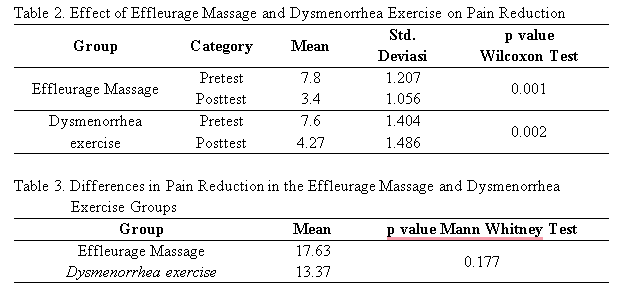
Results: A decrease in pain intensity was observed in 93.3% of participants in the effleurage massage group and 86.7% in the dysmenorrhea exercise group. Both effleurage massage (p=0.001) and dysmenorrhea exercise (p=0.002) significantly reduced menstrual pain. However, no significant difference in pain reduction was found between the two groups (p=0.177).
Conclusion: Effleurage massage and dysmenorrhea exercise are equally effective non-pharmacological interventions for reducing menstrual pain in adolescent girls.
Keywords: Dysmenorrhea, Effleurage massage, Exercise
Downloads
Published
How to Cite
Issue
Section
Citation Check
License
Copyright (c) 2026 Dian Nurafifah, Aulia Kurnianing Putri , Atiul Impartina

This work is licensed under a Creative Commons Attribution 4.0 International License.
- The journal allows the author to hold the copyright of the article without restrictions.
- The journal allows the author(s) to retain publishing rights without restrictions.
- The legal formal aspect of journal publication accessibility refers to Creative Commons Attribution (CC BY).