Family-Driven Support: An Intervention For Successful Exclusive Breastfeeding
DOI:
https://doi.org/10.38040/js.v17iSp.1354Abstract
ABSTRACT
Introduction: Exclusive breastfeeding during the first six months of life is important for infant growth and development, yet national coverage in Indonesia remains below the target. Low family support for breastfeeding mothers is one of the contributing factors. To develop and evaluate the Family-Driven Support model, an intervention that actively involves the immediate family (husband and mother/mother-in-law) to improve exclusive breastfeeding success.
Methods: This study used a quasi-experimental design with a pretest–posttest control group, involving 30 mother-family pairs in the working area of Karanggeneng Community Health Center, Lamongan (15 intervention, 15 control). The intervention included family education classes, couple counseling, digital support via WhatsApp Group, and distribution of a family education booklet. Data were collected using knowledge, attitude, and practice (KAP) questionnaires on family support and indicators of exclusive breastfeeding achievement.
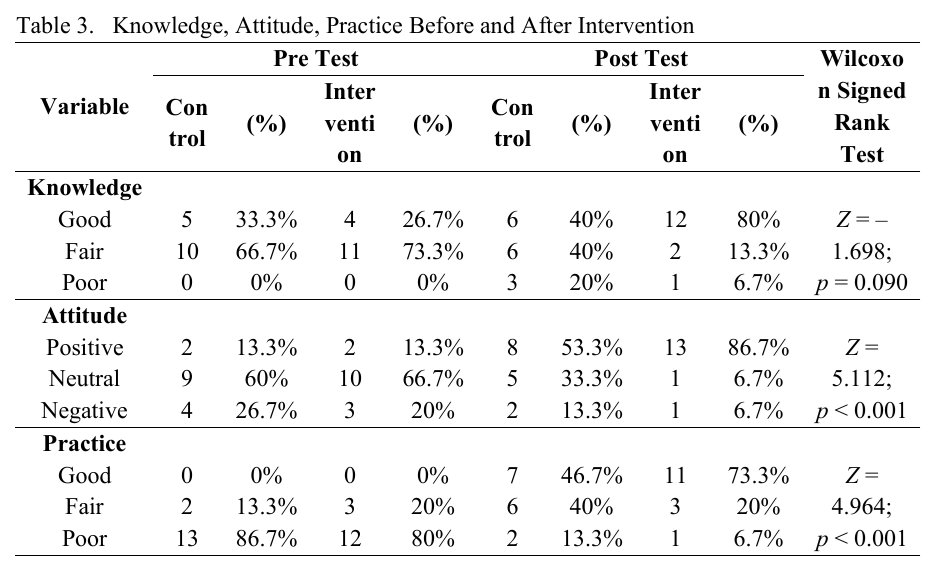
Results: Initial results showed that most families had moderate knowledge (70%), neutral attitudes (63.3%), and low support practices (83.3%). The Family-Driven Support intervention did not significantly improve knowledge (p = 0.090), but successfully enhanced attitudes (p < 0.001) and support practices (p < 0.001) toward exclusive breastfeeding
Conclusion: The Family-Driven Support model has the potential to be an innovative and replicable approach to strengthen family–healthcare collaboration in supporting exclusive breastfeeding success.
Keywords: Family Driven Support, Exclusive breastfeeding, Intervention
Downloads
Published
How to Cite
Issue
Section
Citation Check
License
Copyright (c) 2026 Ihda Mauliyah; Ratih Indah Kartikasari, Shinta Alifiana Rahmawati

This work is licensed under a Creative Commons Attribution 4.0 International License.
- The journal allows the author to hold the copyright of the article without restrictions.
- The journal allows the author(s) to retain publishing rights without restrictions.
- The legal formal aspect of journal publication accessibility refers to Creative Commons Attribution (CC BY).