The Relationship Between The Use of Hormonal Contraception and The Incidence of Mastalgia in Hormonal Contraception Acceptors
DOI:
https://doi.org/10.38040/js.v18i01.1488Abstract
Introduction: The use of hormonal contraception is one of the most popular contraceptive methods among women. However, it has side effects. Mastalgia is a side effect experienced by 70% of women of childbearing age. The aim of this study was to examine the relationship between hormonal contraceptive use and the incidence of mastalgia in hormonal contraceptive users.
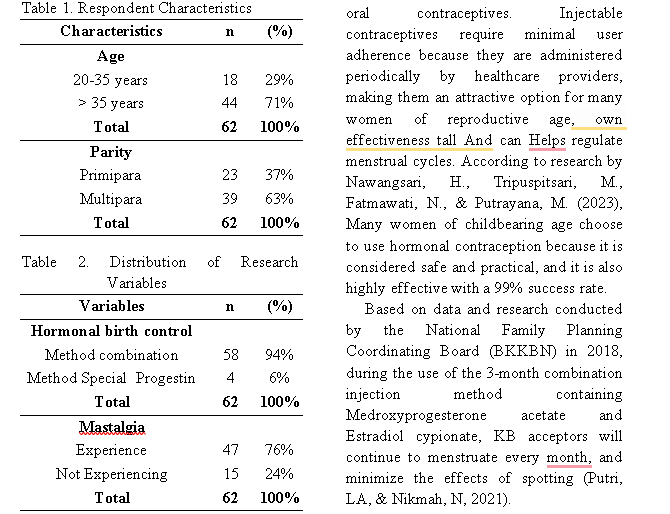
Methods: This study employed an analytical correlational design using a cross-sectional approach. The study population consisted of 73 hormonal contraceptive acceptors. Using simple random sampling, 62 respondents were selected for participation in the study. Data were collected using a structured questionnaire consisting of respondent characteristics, contraceptive history, and mastalgia complaints. The questionnaire was reviewed by experts to establish content validity before data collection. then tabulated and analyzed using the test contingency coefficient with significance level (P-Value) = < 0.05.
Results: Most respondents at Muhammadiyah Kedungpring Primary Clinic used injectable hormonal contraceptive methods. 3 months combination, Most respondents experienced mastalgia and there was a relationship between the use of hormonal contraception and the occurrence of mastalgia with (P-Value) = 0.000 (0.000 < 0.05) This means that there is a relationship between the use of hormonal contraception and the occurrence of mastalgia in hormonal contraception acceptors at the Muhammadiyah Kedungpring Primary Clinic with a correlation value of 0.422 (moderate/sufficient).
Conclusion: Based on the research results above, it can be recommended that every health worker who provides hormonal contraception can inform the patients about its impacts, especially mastalgia, so that they can adapt to these complaints.
Keywords: Acceptors, Hormonal contraception, WUS
Downloads
Published
How to Cite
Issue
Section
Citation Check
License
Copyright (c) 2026 Madras Pamu Sari, sulistiyowati sulistiyowati, Amirul Amalia , Ratih Indah Kartikasari

This work is licensed under a Creative Commons Attribution 4.0 International License.
- The journal allows the author to hold the copyright of the article without restrictions.
- The journal allows the author(s) to retain publishing rights without restrictions.
- The legal formal aspect of journal publication accessibility refers to Creative Commons Attribution (CC BY).