Hormonal Contraception and Duration of Use as Causal Factors for Hypertension in Menopausal Women: A Cross-sectional Study
DOI:
https://doi.org/10.38040/js.v18i02.1493Abstract
Introduction: Menopause occurs in women between ages of 45 and 55. It’s normal phase for women, marked by cessation of menstruation due to decreased estrogen and progesterone levels. This causes blood vessels to become less elastic and triggers an increase in blood pressure. Hypertension can occur in menopausal women due to hormonal changes. One contributing factor is a history of hormonal contraceptive use. This study aims to determine the relationship between a history of hormonal contraceptive use and the incidence of hypertension in menopausal women.
Methods: This study used an observational analytical method with a cross-sectional approach. Population was 134 postmenopausal women with a history of hormonal contraceptive use. Respondents were selected using a purposive sampling technique, with 101 menopausal women selected. Variables studied were the type and duration of hormonal contraceptive use and the incidence of hypertension. The research instruments were questionnaires and observation sheets. Data were analyzed using the Spearman test with SPSS 25 software.
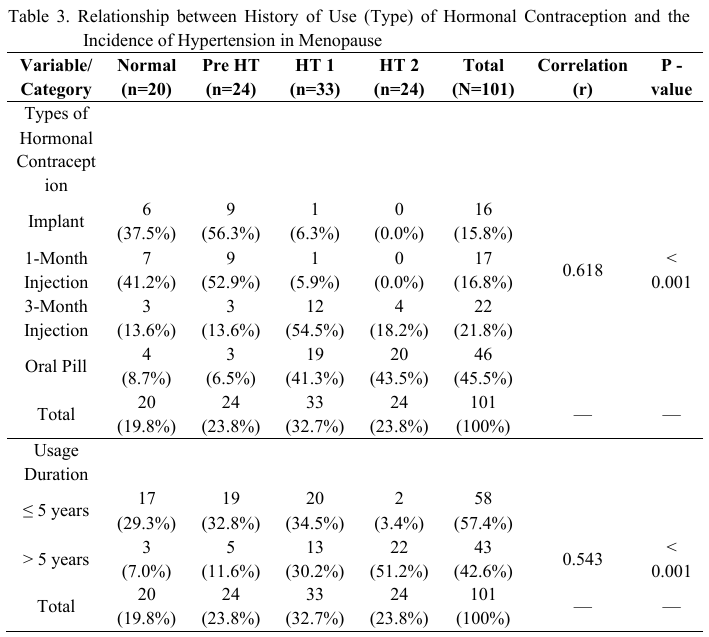
Results: The study showed a significant association between the type of hormonal contraceptive (p=0.000; r=0.618) and incidence of hypertension in menopausal women. Variable duration of hormonal contraceptive use (p=0.000; r=0.513) was associated with the incidence of hypertension in menopausal women. Therefore, hormonal contraceptive use (type and duration of use) is associated with the risk of hypertension in menopausal women.
Conclusion: Health education regarding contraceptive method selection, especially hormonal contraception, and duration of use is crucial. Health workers play a role in assisting in the selection of appropriate contraception.
Keywords: Contraception, Hormone, Hypertension and Menopause
Downloads
Published
How to Cite
Issue
Section
Citation Check
License
Copyright (c) 2026 Lailatul Fadliyah, Yusfina Modesta Rua, Anis Nur Laili, Sofiatun Sofiatun

This work is licensed under a Creative Commons Attribution 4.0 International License.
- The journal allows the author to hold the copyright of the article without restrictions.
- The journal allows the author(s) to retain publishing rights without restrictions.
- The legal formal aspect of journal publication accessibility refers to Creative Commons Attribution (CC BY).